UK employment demand to 2030

Updated: 5 hours ago
Posted on 12 October 2026
Future opportunities are strongest where skills are most needed. By developing specialist knowledge alongside digital, communication and problem-solving skills, students and graduates can position themselves for long-term success in England’s evolving labour market.
The Assessment of Priority Skills to 2030 report published by Skills England in November 2025 estimates that employment is expected to continue moving towards higher-skilled roles, while digital adoption, the transition to net zero, demographic change and rising demand for health and care services alter the mix of skills employers need.
It is projected that demand for jobs in priority occupations is expected to expand significantly by 2030. The most acute likely shortages are concentrated in health and social care, construction and net zero, digital and engineering, where expanding demand coincides with specialist training requirements, replacement needs or constrained supply.
Growth sectors and likely shortage pressure
Growth sector | Occupations most exposed to shortages | Why shortage risk is high |
Health and social care |
| Population ageing increases service demand, while training, professional registration and retention constraints limit the speed at which supply can grow. Replacement needs add further pressure. |
Construction, housing and infrastructure |
| Housing, infrastructure and retrofit activity need skilled workers at the same time. Many roles require apprenticeships, practical experience and safety competence, creating long lead times. |
Net zero and clean energy |
| Decarbonisation raises cross-sector demand for low-carbon design, installation, maintenance and energy-efficiency skills. Capacity is constrained because these skills often build on existing trade or engineering qualifications. |
Digital and information technology |
| Digitalisation affects almost every sector, so employers compete for the same specialist talent. Rapid technology change also makes it difficult for education and training provision to keep pace. |
Professional, scientific and technical services |
| These roles are typically qualification-intensive and depend on a sustained pipeline of STEM entrants. Demand is reinforced by innovation, infrastructure and the net-zero transition. |
Education |
| Demand depends on retaining experienced staff as well as recruiting new entrants. Specialist technical and STEM teaching roles are particularly vulnerable where industry competes for the same expertise. |
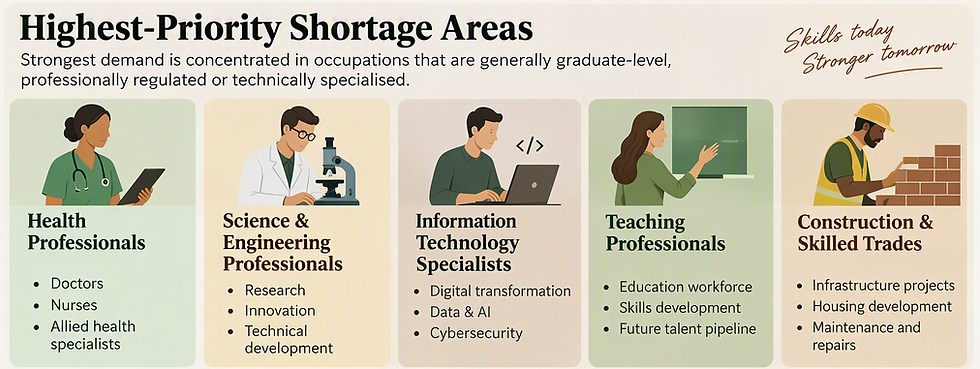
Occupational pattern and skills implications
The priority shortage map points to a common challenge: England needs more people with advanced technical, regulated-professional and skilled-trade capabilities, while also retaining the experienced workforce needed to train and supervise new entrants.
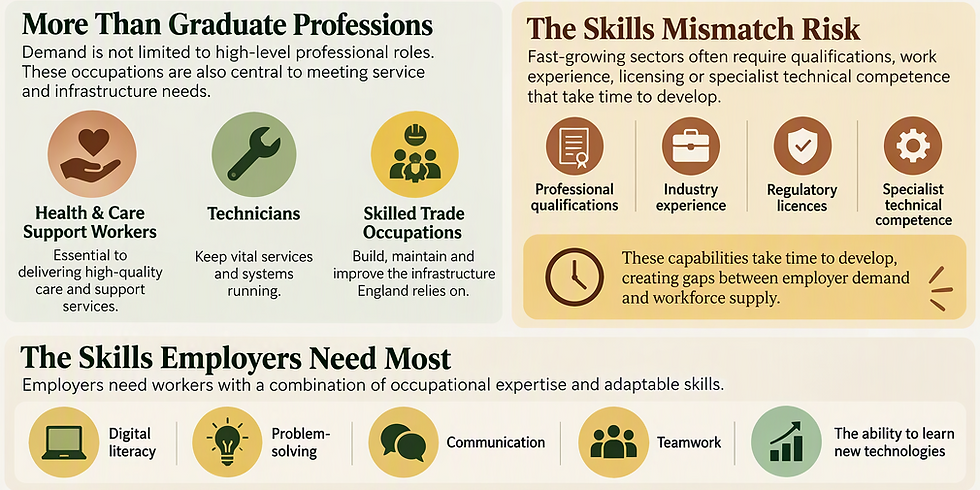
The strongest demand is concentrated in occupations that are generally graduate-level, professionally regulated or technically specialised. Health professionals, science and engineering professionals, information technology specialists, teaching professionals and skilled construction occupations are particularly important. However, demand is not limited to high-level professional roles: health and care support occupations, skilled trades and technician roles are also central to meeting service and infrastructure needs.
A key risk is mismatch between demand and supply. Fast-growing sectors often require qualifications, work experience, licensing or specialist technical competence that take time to develop. Employers therefore need workers with a combination of occupational expertise and adaptable skills: digital literacy, problem-solving, communication, teamwork and the ability to learn new technologies.


Comments